Face Politics Terminal
Budots Media Philippines · research file 2026-10-25 · 中文 · Codex iteration v1

Can a face reveal your politics?

./verdict --subject=faces --target=political_orientation

The answer from ten years of Stanford research: a weak signal across millions of faces, close to a coin flip for any one person.
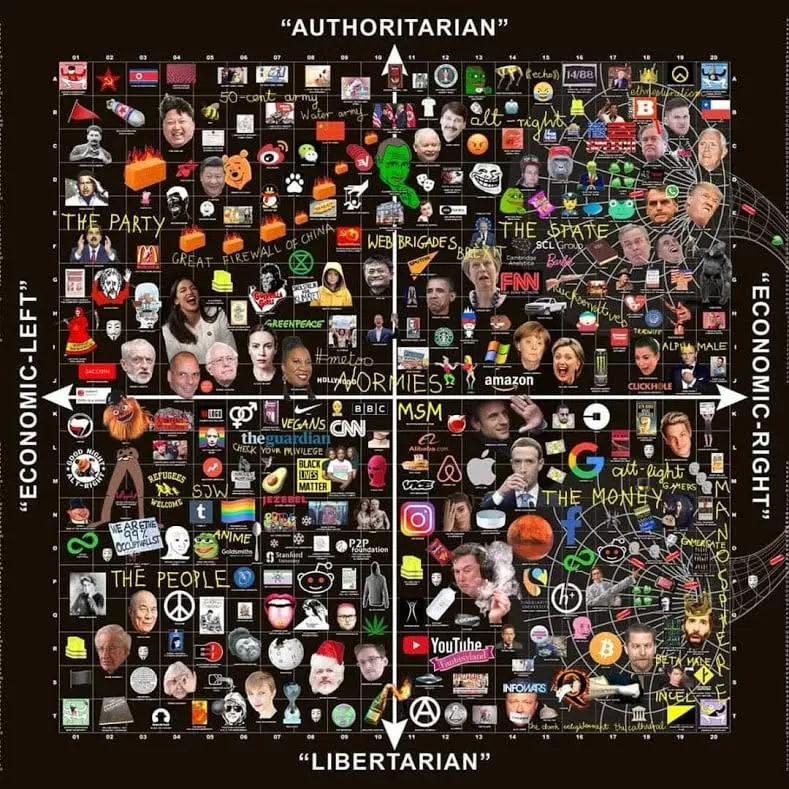

Internet political-compass meme: a 20 by 20 grid with authoritarian–libertarian and economic left–right axes, filled with logos, flags and faces of public figures
Political compass of the internet · meme, author unknown · placements are opinion; this page tests whether faces carry that signal
Road to Unfreedom title over a red theatre curtain and a road running to a city skylinerelated fileRoad to UnfreedomBritain, the US, France and Poland, 1981–2026: laws that changed what a person may say, do and refuse
01 · is it possible?

Groups: barely. One person: no.

Michal Kosinski at Stanford GSB trained face-recognition models to separate liberals from conservatives. Across large samples the models beat chance, so faces carry some information. Once expression, pose and grooming are controlled, that information explains about 5% of the difference between people.

Kosinski presents his results as a privacy warning, not as a working tool.

02 · key stats

The photos and the numbers

2021 · Scientific Reports1,085,795

Dating-site and Facebook photos from the US, UK and Canada. Pairwise score AUC .72; human raters .55.

2024 · American Psychologist591

Lab photos with a neutral face, hair back and no makeup. Algorithm r = .22, humans r = .21.

2024 · politicians check3,401

Real politicians' photos. Correlation only r = .13.

2018 · sexual-orientation study35,326

Dating-site images. Critics traced much of the signal to grooming and camera angle.

03 · probability

Chance of labelling one person correctly

Each published score converted to a single left/right call, with both sides equally common. One block equals 2.5 points; the cyan marker is a coin flip.

test with 20 photos39–78%

95% range around an observed 60%. A handful of photos proves nothing either way.

CCTV crowd of 100,0004,097 : 1

Innocent people flagged per real threat, even with the best published accuracy. Precision 0.024%.

04 · properties

What the models pick up

Head poseIn 2021, liberals more often faced the camera directly.
ExpressionIn 2021, liberals showed more surprise and less disgust.
Lower faceIn 2024, conservatives tended to have a larger lower face. This was the only structural difference reported.
GroomingBeards, glasses, makeup and hair follow subcultures. They drive much of the signal in everyday photos.
DemographicsAge, gender and ethnicity correlate with politics. Adding them raised the 2024 result from r = .22 to .31.
Image itselfLighting, filters and platform style. None of this is biology.
05 · personality & sexual orientation

The same pattern for other traits

Studies of personality and sexual orientation from faces show the same pattern: small effects in large samples, and most of the signal comes from self-presentation.

Selfies → Big FiveKachur et al. 2020: 12,447 volunteers, mean r = .24. The data came from the employer of three of the five authors.
3D face shapeHu et al. 2017 (Shanghai, Fudan): 834 Han Chinese adults. Face shape explains 0.7–4% of personality variance.
Human judgesJaeger et al. 2024: personality impressions from faces are not accurate, and people overestimate their accuracy. Trustworthiness meta-analysis: r = .14.
Hiring and payNBER 2026: "Photo Big 5" scores from LinkedIn photos of 96,000 MBA graduates predict pay and seniority. The authors warn against using it in hiring.
Sexual orientationWang & Kosinski 2018: 81% / 74% pairwise. Leuner 2019: a model on blurred photos still reached 63% / 72%, so much of the signal is not facial structure.
Chatbots with visionJeon et al. 2026: GPT-4o, GPT-4o-mini and LLaVA rated the same campaign ad as more liberal when it showed a woman. The models apply demographic stereotypes.
06 · advertising & political profiling

Where it is used today

Profiling for advertising and politics works through digital footprints: likes, posts and browsing. Faces are used for identity and demographics. No deployed system is documented that targets political ads by face.

Psychological targetingMatz, Kosinski et al. (PNAS 2017): ads matched to personality inferred from Facebook Likes reached 3.5 million people and produced up to 40% more clicks and 50% more purchases.
Cambridge AnalyticaKogan's quiz app harvested data on up to 87 million Facebook users after Stillwell refused CA access to myPersonality (ICO 2018). The UK regulator later found CA's models used "commonly available technology" and that their real-world accuracy "was likely much lower" than claimed (ICO 2020). Facebook paid a $5 billion FTC penalty (2019).
Billboards & retail"Audience analytics" cameras estimate age, gender and emotion to measure or switch ads. A UK station trial in 2024 reportedly used Amazon Rekognition this way.
Face searchClearview AI scraped billions of web photos for police face search and was fined by several European regulators.
RetreatsMeta shut down Facebook face recognition in 2021 and deleted over 1 billion face templates. HireVue dropped facial analysis from hiring interviews in 2021.
PseudoscienceStartups such as Faception have marketed "terrorist" or "high IQ" face classifiers without published validation.
LawEU AI Act Art. 5(1)(g) bans inferring political opinions from biometrics. China: PIPL treats biometrics as sensitive data; the 2025 face-recognition Measures exempt R&D and algorithm training. US: Illinois BIPA, Texas CUBI, California CPRA and FTC enforcement.
07 · who does this research

Companies and labs building trait classifiers

The face models with documented real-world use classify ethnicity, not politics. Most reported cases are Chinese surveillance vendors.

SenseTimeUS Treasury, 2021: software that "can determine a target's ethnicity", with a focus on Uyghurs. SenseTime called this unfounded.
Huawei, MegviiA 2018 test report listed a "Uyghur alert" (IPVM 2020). Huawei called it a test; Megvii said it does not label ethnic groups.
Hikvision, Dahua, UniviewUyghur detection in cameras, analytics and an SDK (IPVM 2019–2023).
Police procurementNYT 2019: one city ran 500,000 checks for Uyghur faces in a month.
Chinese universitiesShanghai Jiao Tong (criminality, 2016), Dalian Minzu (ethnicity, under an Expression of Concern), CAS Institute of Psychology, Fudan and NWPU Xi'an (personality).
ElsewhereStanford (Kosinski), Denmark (ideology from candidate photos, 61%), Russia/UK (Kachur, selfies), Israel (Faception).
08 · research team
Bart Sakwerda in a CCTV frame with face-detection boxes

Bart Sakwerda

Principal investigator · Budots Media Philippines. Security, CCTV and digital-twin projects.

credits --orchestration

Research workflow orchestrated by Claude Opus 5.5 (Anthropic): literature and GitHub survey, simulation, this site. Kimi and ChatGPT Codex are invited to verify.

09 · sources

Sources by topic

Each entry was opened online on 24–25 Oct 2026 unless tagged. Probabilities come from the project simulation (experiments/sim_single_photo_limits.py). Full list with status: references/bibliography.md.

Political orientation from faces · 5
  1. Kosinski, M. (2021). Facial recognition technology can expose political orientation from naturalistic facial images. Scientific Reports 11, 100. doi — 1,085,795 dating-site and Facebook photos (US, UK, Canada); pairwise AUC .72, human raters .55.
  2. Kosinski, M., Khambatta, P., & Wang, Y. (2024). Facial recognition technology and human raters can predict political orientation from images of expressionless faces even when controlling for demographics and self-presentation. American Psychologist 79(7), 942–955. doi · arXiv — 591 lab photos: algorithm r = .22, humans r = .21, r = .31 with age, gender and ethnicity; 3,401 politicians r = .13.
  3. Rasmussen, S. H. R., Ludeke, S. G., & Klemmensen, R. (2023). Using deep learning to predict ideology from facial photographs. Scientific Reports 13, 5257. doi — 3,323 Danish candidates, 61% accuracy. Predictions tracked smiling and, for women, attractiveness; the model also used areas outside the face.
  4. Lindholm, A., Hjorth, F., & Schuessler, J. (2025). Facial finetuning: using pretrained image classification models to predict politicians' success. Political Science Research and Methods 13(4), 1031–1041. doi — 7,080 Danish politicians; model scores for attractiveness and trustworthiness correlate with votes.
  5. Rule, N. O., & Ambady, N. (2010). Democrats and Republicans can be differentiated from their faces. PLoS ONE 5(1), e8733. doi — human judges above chance on candidate photos.
Personality from faces · 10
  1. Kachur, A., Osin, E., Davydov, D., Shutilov, K., & Novokshonov, A. (2020). Assessing the Big Five personality traits using real-life static facial images. Scientific Reports 10, 8487. doi — 12,447 volunteers, 31,367 photos; mean r = .24 with self-reports. Three of the five authors worked for the company that supplied the data.
  2. Guenzel, M., Kogan, S., Niessner, M., & Shue, K. (2026). AI personality extraction from faces: Labor market implications. NBER Working Paper 34808. NBER — LinkedIn photos of about 96,000 MBA graduates; "Photo Big 5" scores (Kachur model) predict pay, seniority and job moves. The authors warn against use in hiring.
  3. Hu, S., Xiong, J., Fu, P., et al. (2017). Signatures of personality on dense 3D facial images. Scientific Reports 7, 73. doi — 3D scans of 834 Han Chinese adults (CAS-MPG Shanghai, Fudan); face shape explains 0.67–3.95% of personality variance.
  4. Xu, J., Tian, W., Lv, G., Liu, S., & Fan, Y. (2021). Prediction of the Big Five personality traits using static facial images of college students with different academic backgrounds. IEEE Access 9, 76822–76832. doi — Northwestern Polytechnical University, Xi'an; 13,347 student photo–questionnaire pairs; "above 70%" accuracy on binned classes, not comparable with correlations.
  5. Cai, L., & Liu, X. (2022). Identifying Big Five personality traits based on facial behavior analysis. Frontiers in Public Health 10, 1001828. doi — Institute of Psychology, CAS; facial movement in 30-second videos, N = 82, r = .39–.48, no independent test sample.
  6. Jaeger, B., Sleegers, W. W. A., Stern, J., Penke, L., & Jones, A. L. (2024). Testing perceivers' accuracy and accuracy awareness when forming personality impressions from faces. European Journal of Personality 38(6), 907–927. doi — preregistered: human face impressions of personality are not accurate, and people overestimate their accuracy.
  7. Foo, Y. Z., Sutherland, C. A. M., Burton, N. S., Nakagawa, S., & Rhodes, G. (2022). Accuracy in facial trustworthiness impressions: Kernel of truth or modern physiognomy? A meta-analysis. Personality and Social Psychology Bulletin 48(11), 1580–1596. doi — face-level r = .14, "unlikely to be of practical utility".
  8. Hinds, J., & Joinson, A. (2024). Digital data and personality: A systematic review and meta-analysis. Psychological Bulletin 150(6), 727–766. doi — benchmark across all digital footprints: computer prediction pooled ρ = .30 (42 studies).
  9. Kosinski, M. (2017). Facial width-to-height ratio does not predict self-reported behavioral tendencies. Psychological Science 28(11), 1675–1682. doi — a null result from Kosinski himself.
  10. 刘晨, 温芳芳, 佐斌 (2019). 以貌取人可行吗?——基于面孔的特质推理及准确性. 《心理科学》42(1), 150–156. jps.ecnu.edu.cn中文 — Central China Normal University review: face-based trait inference has "moderate accuracy" that depends on target, perceiver, culture and context.
Sexual orientation from faces · 7
  1. Wang, Y., & Kosinski, M. (2018). Deep neural networks are more accurate than humans at detecting sexual orientation from facial images. Journal of Personality and Social Psychology 114(2), 246–257. doi — 35,326 dating-site images; pairwise accuracy 81% (men) and 74% (women) from one image.
  2. Leuner, J. (2019). A replication study: Machine learning models are capable of predicting sexual orientation from facial images. arXiv 1902.10739 — 20,910 new dating-site photos: 68% / 77%. A model on blurred photos still reached 63% / 72%, so much of the signal is not facial structure.
  3. Agüera y Arcas, B., Todorov, A., & Mitchell, M. (2018). Do algorithms reveal sexual orientation or just expose our stereotypes? Medium. archive — glasses, makeup, facial hair and selfie angle differ between groups.
  4. Gelman, A., Mattson, G., & Simpson, D. (2018). Gaydar and the fallacy of decontextualized measurement. Sociological Science 5, 270–280. doi — the classifier measures self-presentation on a dating site, not orientation in the population.
  5. GLAAD & Human Rights Campaign (2017). Joint statement on the Stanford study.unverified — called it "dangerous and flawed"; the primary page was not reachable, quotes come from press reports.
  6. 积木 (2017). 看脸的世界?通过面部识别技术,AI 可以了解许多个人信息. 爱范儿. ifanr.com中文 · 方嘉文 (2017). 你以为人工智能看出了"直"或"弯"?它只是看出了你的偏见. 爱范儿. ifanr.com中文 — Chinese coverage of the study and of the Western critiques.
  7. 柯鸣 (2018). 性取向被识别后,AI伦理的边界又在哪里? 36氪. 36kr.com中文 — commentary on AI ethics after the study, with a Sun Yat-sen University relationship-recognition model.

No peer-reviewed replication on a new population (2020–2026) and no test of vision-language models for sexual orientation was found.

AI models and stereotypes · 3
  1. Jeon, S., Lee, M. H. J., Montgomery, J. M., & Lai, C. K. (2026). From faces to politics: Vision-language models (sometimes) link visual demographic characteristics to ideological labels. Political Analysis 34(4), 613–621. doi — GPT-4o, GPT-4o-mini and LLaVA rated identical ads with women as more liberal (b = .41 against a survey gap of .15); Gemini refused to rate faces.
  2. Hausladen, C. I., Knott, M., Camerer, C. F., & Perona, P. (2025). Social perception of faces in a vision-language model. FAccT '25, 639–659. doi · arXiv — CLIP's judgments shift with expression more than with age, and with lighting about as much as with age.
  3. Peterson, J. C., Uddenberg, S., Griffiths, T. L., Todorov, A., & Suchow, J. W. (2022). Deep models of superficial face judgments. PNAS 119(17), e2115228119. doi · One Million Impressions — models how people judge synthetic faces.
Critiques and the history of physiognomy · 7
  1. Agüera y Arcas, B., Mitchell, M., & Todorov, A. (2017). Physiognomy's new clothes. Medium. summary
  2. Stark, L., & Hutson, J. (2022). Physiognomic artificial intelligence. Fordham Intellectual Property, Media & Entertainment Law Journal 32(4). Fordham — defines "physiognomic AI" and argues for legal bans.
  3. Andrews, M., Smart, A., & Birhane, A. (2024). The reanimation of pseudoscience in machine learning and its ethical repercussions. Patterns 5(9), 101027. doi — discusses Kosinski 2024, Wang & Kosinski 2018, Wu & Zhang 2016 and Kachur 2020.
  4. Todorov, A., Olivola, C. Y., Dotsch, R., & Mende-Siedlecki, P. (2015). Social attributions from faces. Annual Review of Psychology 66, 519–545. doi · Todorov, A. (2017). Face Value. Princeton University Press.
  5. Wu, X., & Zhang, X. (2016). Automated inference on criminality using face images. arXiv 1611.04135 — Shanghai Jiao Tong University; ID photos of convicted men against web photos of others, a sampling confound. Version 3 (2017) is the authors' reply to critics.
  6. 虞涵棋, 杨漾 (2017). 谷歌研究员质疑"看脸识罪犯",交大教授撰文:我被扣帽子了. 澎湃新闻. thepaper.cn中文 — Wu Xiaolin's response; reports 1,856 photos and 89% claimed accuracy.
  7. Eckles, D., Gordon, B. R., & Johnson, G. A. (2018). Field studies of psychologically targeted ads face threats to internal validity. PNAS 115(23). doi — Facebook's ad delivery means the Matz 2017 arms were not randomised comparisons.
Cambridge Analytica and psychographic targeting · 14
  1. Kosinski, M., Stillwell, D., & Graepel, T. (2013). Private traits and attributes are predictable from digital records of human behavior. PNAS 110(15), 5802–5805. doi — Facebook Likes predict personality, politics and sexual orientation.
  2. Youyou, W., Kosinski, M., & Stillwell, D. (2015). Computer-based personality judgments are more accurate than those made by humans. PNAS 112(4), 1036–1040. doi
  3. University of Cambridge Psychometrics Centre. myPersonality. psychometrics.cam.ac.uk — "no longer active and data is no longer being shared"; over 6 million volunteers until 2012.
  4. Information Commissioner's Office (2018). Investigation into the use of data analytics in political campaigns. ICO (PDF) — up to 87 million Facebook users; Stillwell refused Cambridge Analytica access to myPersonality, so Kogan built his own app; £500,000 penalty for Facebook.
  5. Denham, E. (2020). Letter to the DCMS Committee on the ICO investigation. ICO (PDF) — the models were "well recognised processes using commonly available technology"; real-world accuracy on new people "was likely much lower"; GSR data could not have been used in the Brexit referendum.
  6. House of Commons DCMS Committee (2019). Disinformation and 'fake news': Final Report, HC 1791. PDF · Oral evidence of C. Wylie, 27 Mar 2018, HC 363. parliament.ukpartly verified
  7. US Federal Trade Commission (2019). Final settlement with Cambridge Analytica's former CEO and the app developer. ftc.gov · $5 billion penalty for Facebook. ftc.gov — the harvested data and derived models had to be deleted.
  8. Matz, S. C., Kosinski, M., Nave, G., & Stillwell, D. J. (2017). Psychological targeting as an effective approach to digital mass persuasion. PNAS 114(48), 12714–12719. doi — 3.5 million people reached; up to 40% more clicks and 50% more purchases.
  9. Tappin, B. M., Wittenberg, C., Hewitt, L. B., Berinsky, A. J., & Rand, D. G. (2023). Quantifying the potential persuasive returns to political microtargeting. PNAS 120(25), e2216261120. doi — targeting on more than one attribute added nothing; gains may not need large amounts of personal data.
  10. Simchon, A., Edwards, M., & Lewandowsky, S. (2024). The persuasive effects of political microtargeting in the age of generative AI. PNAS Nexus 3(2), pgae035. doi · Matz, S. C., et al. (2024). The potential of generative AI for personalized persuasion at scale. Scientific Reports 14, 4692. doi
  11. Gibney, E. (2018). The scant science behind Cambridge Analytica's controversial marketing techniques. Nature. doi · Allen, J., & Abbruzzese, J. (2018). Cambridge Analytica's effectiveness called into question. NBC News. nbcnews.com
  12. Bakir, V. (2020). Psychological operations in digital political campaigns: Assessing Cambridge Analytica's psychographic profiling and targeting. Frontiers in Communication 5, 67. doi · Hersh, E. D. (2015). Hacking the Electorate. Cambridge University Press. doi
  13. Lomas, N. (2020). Latest Cambridge Analytica leaks ("Hindsight Files"). TechCrunch. techcrunch.com — internal documents released by Brittany Kaiser; no public index found.
  14. DeepTech深科技 (2018). "剑桥分析"究竟如何通过"点赞"来影响投票倾向? 安全内参. secrss.com中文 — Chinese explainer; notes that evidence the method swung elections is lacking.

Data. Public: the ICO, FTC and DCMS documents above. Not public: the profiles harvested by Kogan's app (deletion ordered by the FTC; seized copies destroyed by the ICO) and the myPersonality dataset (sharing stopped in 2018). This project links to the official record and does not use leaked copies.

Who builds it: companies and labs · 9
  1. US Treasury (10 Dec 2021). Sanctions on SenseTime. treasury.gov — says its software "can determine a target's ethnicity, with a particular focus on identifying ethnic Uyghurs". SenseTime called the accusations unfounded.
  2. US Treasury (16 Dec 2021). Chinese military-industrial complex companies, incl. Megvii, Yitu, CloudWalk. treasury.gov
  3. IPVM (2020). Huawei / Megvii "Uyghur alert" test report. ipvm.com — Huawei: "simply a test"; Megvii: not designed to label ethnic groups.
  4. Rollet, C. (2020). Uniview Uyghur recognition. IPVM. ipvm.com — an SDK ethnicity code listing only Uyghurs; also cites Hikvision (2019) and Dahua (2020).
  5. Asher-Schapiro, A. (2021). Chinese tech patents tools that can detect, track Uighurs. Thomson Reuters Foundation. context.news — Huawei + CAS, Megvii and Alibaba patent filings; company replies included.
  6. Wang, C., Zhang, Q., Liu, W., Liu, Y., & Miao, L. (2019). Facial feature discovery for ethnicity recognition. WIREs Data Mining and Knowledge Discovery 9(1), e1278. doi · IPVM (2021) on its ethics. ipvm.com — Dalian Minzu University with Curtin University; 300 Uyghur, Tibetan and Korean students; Expression of Concern, no retraction registered.
  7. Mozur, P. (2019). One month, 500,000 face scans: How China is using A.I. to profile a minority. The New York Times. nytimes.compartly verified
  8. Human Rights Watch (2017). China: Voice biometric collection threatens privacy. hrw.org — iFlytek; voice, not face.
  9. Globes (2016). Israeli co Faception claims it can spot terrorists. globes.co.il — 15 "classifiers" at a claimed 80%, no published validation.
Law: EU, China, US · 5
  1. Regulation (EU) 2024/1689 (AI Act), Art. 5(1)(g). EUR-Lex — bans biometric categorisation that infers race, political opinions, religion, sex life or sexual orientation.
  2. 《中华人民共和国个人信息保护法》 (2021), Art. 28–29. cac.gov.cn中文 — biometrics and religious belief are sensitive personal information; separate consent required. No named ban on inferring politics.
  3. 最高人民法院关于审理使用人脸识别技术处理个人信息相关民事案件适用法律若干问题的规定, 法释〔2021〕15号. court.gov.cn中文 — face verification, identification or analysis in public places in breach of law infringes personality rights.
  4. 国家互联网信息办公室、公安部《人脸识别技术应用安全管理办法》 (2025), in force 1 June 2025. cac.gov.cn中文 — Art. 2(2) exempts R&D and algorithm training; filing required above 100,000 people.
  5. US: Illinois BIPA, Texas CUBI, California CPRA, FTC enforcement (Rite Aid, 2023).from memory